

1·
3 months agoIf they really wanted to avoid abuse, they would require a court order for any search carried out by law enforcement.
If they really wanted to avoid abuse, they would require a court order for any search carried out by law enforcement.
There are a few ways to store excess energy generated during the day. Usually batteries are the obvious answer.
One of the great things about batteries is that the metal used in them is recyclable and can be repurposed to make new batteries. So, at some point, we’ll barely need to be mining the metals used in those.
Compare that to petroleum products which, if not for green energy, would always needs to be extracting more and more to be able to satisfy an increasing demand of energy.
From reading the article and watching the video, it didn’t sound like they were refusing the option of having a union. It was more that they wanted to have an official vote on the matter, and didn’t want to be pressured into a decision on the spot:
[W]e believe a secret-ballot election conducted by the National Labor Relations Board is the appropriate path forward. This process protects individual choice and ensures that any outcome reflects the collective will of those eligible to participate.
I wonder what the results would have looked like if they added questions to see the difference in acceptance between banning smartphones vs banning dumb phones.
By taking on the meme generator, Saflor may hit a wall if the court finds that his arguments apply to any meme generator and a finding in his favor could risk undercutting the entire meme ecosystem, Goldman said.
This will definitely be an interesting case to watch unfold. In my opinion it could definitely be a win if websites that run any kind of meme generator are forced to pay the official artist to have their template on their site.
This doesn’t really seem fitting to this sub, but I guess this is tech related news because they have multiple websites?
In most countries, the output of a single prompt will not be copyrightable. However, once someone starts arranging the output into something more, then copyright can be applied.
Overall, it depends on the country, but in some they are asking their legislators for clarification. Many are trying to apply pre-existing copyright laws to LLMs.
The U.S. Copyright Office wrote up a report about this and included a list of how other countries are handling it.
https://www.copyright.gov/ai/Copyright-and-Artificial-Intelligence-Part-2-Copyrightability-Report.pdf

A copay is the amount that you pay for certain healthcare expenses. The rest is paid for by your insurance company.
knowingly, intentionally continue to fund neo-Nazis in Sweden.
Am I understanding you correctly that you’re accusing anyone who continues to use Mullvad as someone who supports neo-Nazis in Sweden?
Looks like someone is already asking them for clarification in this thread here: https://codeberg.org/Codeberg/Community/issues/2929
Maybe the banner will be updated to more closely match what Defnulls said. Unless that banner changes it’s certainly not a stretch to say that “Cryptocurrency projects are no longer allowed.”
If that’s supposed to be the correct interpretation, why does the top of the site now state, “Cryptocurrency projects are no longer allowed. View change”?
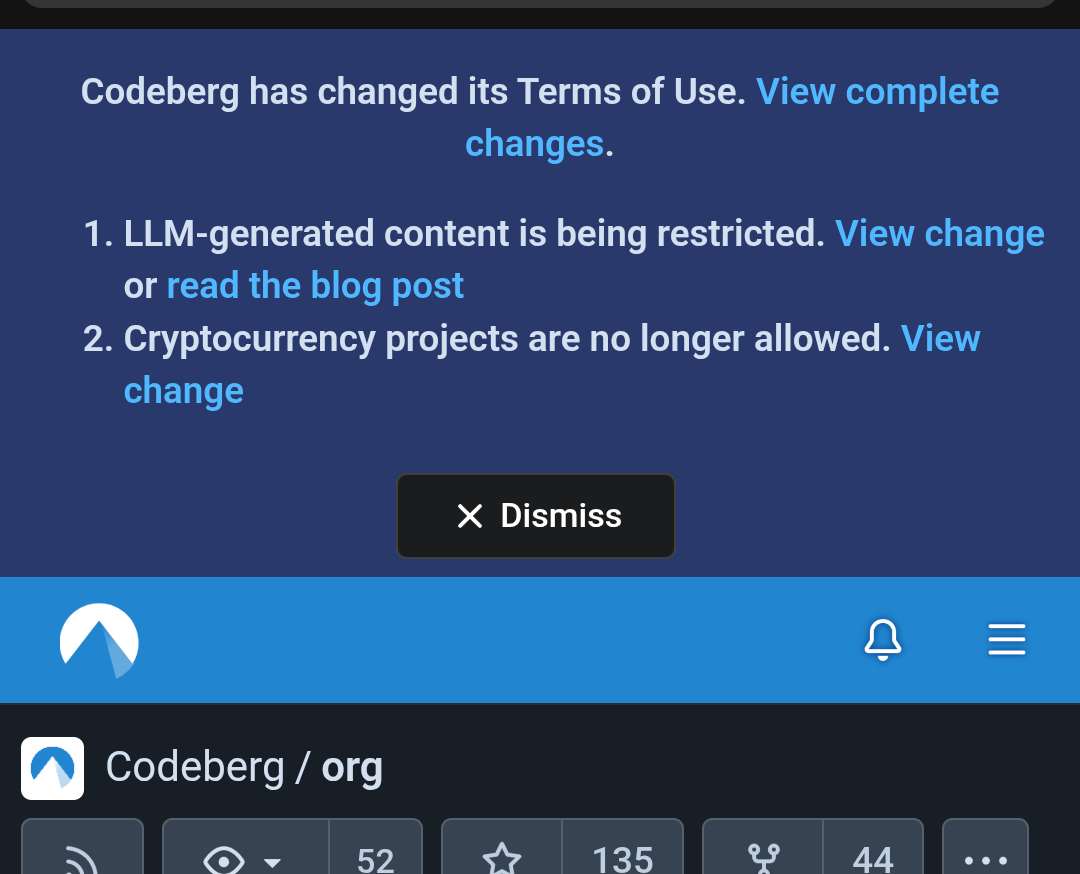
I’m wondering if there’s some grace period for projects to migrate, or if they just start locking projects down immediately after their community votes to ban something.
It’s a little hard to argue that when the top of the site now says, “Cryptocurrency projects are no longer allowed. View change”.
For “AI editing”, I don’t have much of a problem if a model was trained to tweak the settings in something like Darktable to achieve a good baseline to start with. However, for contributing to research like this, I draw the line when models start generating their own pixels and overwriting the original image.
Hopefully iNaturalist and other similar groups start to look at the metadata of submitted images to help warn/educate end users about this problem. That would at least help with the AI literacy issue. Those metadata tags are already being placed there by the most popularly used tools.
A lot of users here seem to be under the misconception that these are 100% AI generated images.
The problem isn’t really with that as the article states that this is an issue with using AI in the editing process:
Outright hoaxes remain rare and are often easy to spot, said Lees – nobody is falling for a toucan sighting in Siberia – but he says birders often use AI to edit and improve an image, and the algorithm can then introduce parts from different bird species to create the new image.
It’s also worth noting that some phones allow you to zoom in beyond your camera’s normal capabilities by using AI to enhance the picture. With some algorithms this might not be an issue, but if it’s using a model that’s been trained by some animal/object database then this can introduce innaccuracies that would cause problems for researchers trying to keep their database clean.
It works at full resolution, but it’s a cat and mouse game. If something like this becomes popular, then all that needs to be done is to start passing images through a filter first (blur, lower resolution, etc.), or just train a new vision model that can pick out both the blurred message as well as the decoy message.
Some candidates just don’t have a lot of public information available about them. Relying on their campaign page alone can tell you which audience they’re trying to get votes from, but it doesn’t always line up with how they’ll actually act.
There are varying degrees of bad to good ways of utilizing LLMs for something like this.
The worst way is to just straight up ask it who to vote for. I doubt this is how it’s being used. Most likely people are telling it what kind of political views they hold and then asking which candidate supports those views. Still a terrible way to handle the situation since it’s not hard for an LLM to hallucinate information, especially when candidates have similar names to others in its training.
Having a long political chat with a non-local LLM is a quick way to let companies create a political profile on all of their users.
One good way would be to use a locally run LLM, provide a bunch of source material (every bill they’ve written/sponsored), and ask it to find evidence that a candidate supports particular viewpoints. Ask it to point directly to where in the source material that reinforces/conflicts with those viewpoints. Then double check the flagged source material for accuracy.