Celsius is great for engineering because Things Happen™️ when water starts boiling or freezing. But most people aren’t engineering daily.
I’d argue that it’s more covenient to use a common scale for all applications of the same measurement than to have multiple different scales, just because that would eliminate all conversion concerns. Someone I know is in engineering school has switched entirely to using °C simply because that’s what they deal with at school anyway, to the point they don’t even write °C anymore in casual chats.
For other applications, it seems like the scales we’re used to are more or less arbitrary anyway, so that’s really just a matter of getting used to it. Some are used to calling ~70°F room temperature, others say ~20°C,
So if it matters for one case, but not so much for others, and we were to pick a single scale, I should think it would be ideal to go with the case where it does matter.
Or we just keep doing this thing where people use what they’re used to and we just quickly look it up or someone comments with the conversion and move on with our lives.
Just joking around, but setting a scale is just a matter of fixing zero and choosing the size of your degree. So -50º would be halfway to absolute zero and 0º can be any reference point you want.


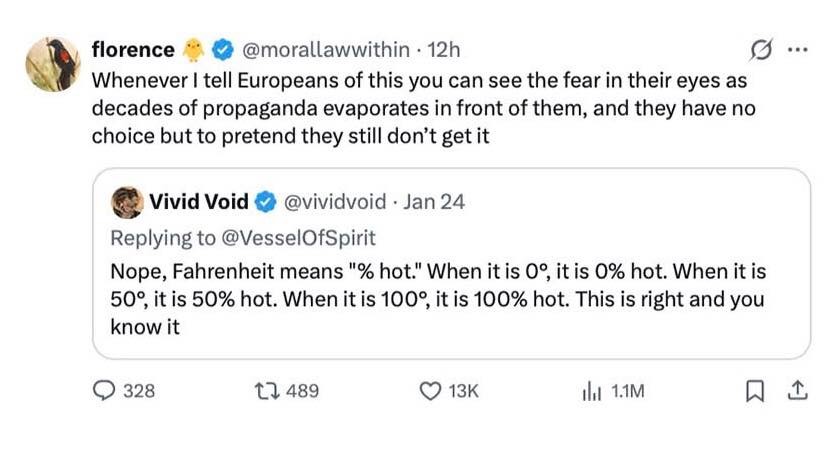
I’d argue that it’s more covenient to use a common scale for all applications of the same measurement than to have multiple different scales, just because that would eliminate all conversion concerns. Someone I know is in engineering school has switched entirely to using °C simply because that’s what they deal with at school anyway, to the point they don’t even write °C anymore in casual chats.
For other applications, it seems like the scales we’re used to are more or less arbitrary anyway, so that’s really just a matter of getting used to it. Some are used to calling ~70°F room temperature, others say ~20°C,
So if it matters for one case, but not so much for others, and we were to pick a single scale, I should think it would be ideal to go with the case where it does matter.
Or we just keep doing this thing where people use what they’re used to and we just quickly look it up or someone comments with the conversion and move on with our lives.
I’ll agree to a single universal scale but only on the condition that -100º=0ºK
K doesn’t use the ° symbol ;)
And the increments of kelvin are the same as Celsius, they’re just at different points, where at 0K absolutely nothing is a gas or a liquid.
(Trying to decipher it right but you’re suggesting 0K be renamed -100°??
My bad, don’t use Kelvin all that often 😂
Just joking around, but setting a scale is just a matter of fixing zero and choosing the size of your degree. So -50º would be halfway to absolute zero and 0º can be any reference point you want.